
Program Overview
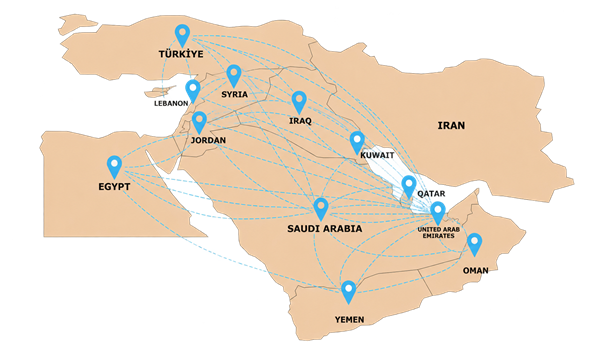
🔷 Regional Map: Recruitment Network
MECUD connects clinical and research institutions across the Middle East through a distributed network of clinical recruitment nodes, sequencing and analysis hubs, biobanking facilities and functional research groups.
Participating clinical centres identify and consent eligible patients, undertake standardised phenotyping and collect relevant biological samples. Where local sequencing capacity is unavailable, samples can be transferred under agreed consent, governance and material-transfer frameworks to designated sequencing hubs within the network.
Genomic data remain under the stewardship of the institutions that generate or host them. Federated-access models enable authorised collaborators to interrogate relevant genomic and phenotypic information for joint analysis and interpretation without requiring all sensitive information to be transferred to a central repository.
The regional map below shows participating institutions and the complementary capabilities available across the collaborative.
🔷 Program Milestones
Launch of the regional collaborative
MECUD is established as a cross-border collaborative coordinated through the MENA-Medical Genetics Association (MENA-MGA) and involving partner institutions across the Middle East. Initial governance, ethics, consent, data-access and sample-transfer frameworks are developed. Clinical recruitment nodes, sequencing capabilities, biobanking pathways and secure federated analytical infrastructure begin operation.
2027 — Initial cohorts and network consolidation
Expansion of cross-border recruitment and analysis Multi-country patient recruitment expands across participating sites. Standardised phenotyping, sequencing, reanalysis, case matching and collaborative interpretation workflows are implemented and evaluated. Initial regional diagnoses and candidate gene discoveries are generated.
2028 — Regional expansion and functional validation
Activation of distributed functional capabilities The network expands access to functional-genomics expertise, including patient-derived cellular systems and appropriate experimental models. MECUD develops mechanisms for connecting candidate variants, genes and biomarkers to laboratories with the relevant experimental capability.
2029 — Federated data integration and discovery
Federated genomic analysis and regional discovery Federated analytical approaches support authorised cross-institutional analysis while participating institutions retain stewardship of sensitive genomic data. Regional case matching, variant interpretation and gene-discovery activities expand, with clinically and scientifically important findings returned to participating centres.
Avoid fixed claims such as predetermined numbers of biomarkers or disease genes unless these are formally approved programme targets.
2030 — Sustainable regional collaboration
Long-term sustainability and regional integration MECUD develops a diversified sustainability model combining institutional and national support, joint regional and international grant applications and, as the collaborative demonstrates impact, larger collaborative and philanthropic funding opportunities. Cross-border case review, training and shared genomic and functional research activities become embedded within the network.
Remove the current emphasis on service-based revenue and IP licensing as the principal sustainability model.
Dashboard - Data & Insights
📊 Dashboard Overview
The MECUD dashboard provides a data-driven overview of collaborative activity across participating institutions, including patient recruitment, genomic investigation, diagnostic outcomes and regional participation.
Where permitted by governance and participant consent, aggregated metrics can illustrate how unresolved cases progress through reanalysis, case matching and complementary genomic or functional investigation.
📊 Demographics
Age Distribution
Sex Ratio
Top Referring Countries
Disease Categories
🧬 Genomic Analytics Snapshot
Sequencing Performed
WGS: 892 | WES: 1,456 | RNA-seq: 234
Average Turnaround Time
45 days (from sample receipt to report)
Diagnostic Yield by Category
Neurology: 42% | Metabolic: 38% | Immunology: 35%
Multi-omics Integration
156 cases with integrated genomic and transcriptomic data
🌍 Regional Reach
MECUD operates as a distributed regional collaborative connecting clinical recruitment sites, sequencing laboratories, biobanks, analytical groups and functional research teams across participating Middle Eastern countries. The map below illustrates the institutions currently contributing patients, data, analysis or specialist capabilities to the network.
10 Countries
Active in MENA Region
23+ Centers
Partner Institutions
Regional Hub
Regional Coordination — MENA-Medical Genetics Association (MENA-MGA)
📈 Trends & Pipeline Metrics
Monthly Recruitment & Sequencing Throughput
Patient Journey Funnel
Logistics & Participation
📋 Participation Methodology
Patients meeting MECUD eligibility criteria are identified through participating clinical centres and enrolled under locally approved consent and governance frameworks. Clinical sites undertake detailed phenotyping and collect relevant biological samples.
Centres without local sequencing capacity may transfer appropriate samples, under agreed material-transfer and governance arrangements, to designated sequencing hubs within the network. Samples or derived materials can be securely biobanked at participating facilities using harmonised standards for storage, access, tracking and future use.
Sequencing institutions generate and analyse genomic data while retaining institutional stewardship. Federated-access models allow authorised collaborators across MECUD to interrogate relevant genomic and phenotypic information for joint interpretation without requiring all sensitive data to be transferred to a single repository.
When candidate variants, genes or biomarkers require experimental evidence, cases can be connected to appropriate functional capabilities elsewhere in the network.
🧭 Enrollment Overview
Identify Eligible Patient
Clinician identifies a patient meeting MECUD inclusion criteria.
Consent and phenotype
Obtain locally approved informed consent and record standardised clinical and phenotypic information.
Collect and biobank samples
Collect, document and securely store appropriate biological samples.
Connect to appropriate genomic capability
Undertake local sequencing where available or transfer samples to a designated MECUD sequencing hub.
Collaborative analysis and return of findings
Analyse data using local and federated approaches, undertake case matching and communicate validated findings through the responsible clinical team.
🚚 Shipping Workflow
🧫 Recruitment Centers
Each participating institution contributes according to its capabilities. Some centres primarily serve as clinical recruitment nodes, identifying patients, undertaking phenotyping and collecting samples. Others provide sequencing, bioinformatics, biobanking, multi-omics or functional-validation capabilities.
MECUD connects these complementary strengths through common phenotypic standards, shared governance and federated analytical approaches. Participating researchers remain actively involved in interpretation and discovery, allowing the network to function as a collaborative regional system rather than a unidirectional sample-referral programme.
| Country | Center | Principal Investigator | Contact |
|---|---|---|---|
| United Arab Emirates | Dubai Health / MBRU | Omer Alkhnbashi | TBA |
| Kuwait | Dasman Diabetes Institute | Hamad Ali | TBA |
| Oman | Sultan Qaboos University | Almundher Al-maawali | TBA |
| Saudi Arabia | Taibah University | Naif A. Almontashiri | TBA |
| Turkey | Izmir Biomedicine and Genome Center (IBG) | Uğur Özbek | TBA |
| Egypt | Human Genetics, and Genome Research Institute National Research Centre (NRC) | Maha S. Zak | TBA |
| Syria | Damascus University | Mouhammed Ali Ajlouny | TBA |
| Jordan | Biolab Diagnostic Laboratories | Issa Abu-Dayyeh | TBA |
| Lebanon | American University of Beirut Medical Center (AUBMC) | Rami Abdel-Rahim Mahfouz | TBA |
| Yemen | Hadhramout Telemedicine Organization | Abdullah M. Baghfar | TBA |
| Iraq | University of Duhok, Duhok | Khalaf Hussein Gargary | TBA |
| Yemen | Al-Arab University | Ali M. Batarfi | TBA |
| Kuwait | Kuwait University | Barrak Alahmad | TBA |
| Kuwait | Dasman Diabetes Institute | Abdullah Alibrahim | TBA |
| Kuwait | Kuwait University | Dana Marafi | TBA |
| Kuwait | Kuwait University | Hind Alsharhan | TBA |
| Kuwait | Authority For Medical Responsibility | Salman Al Sabah | TBA |
| Turkey | Abdullah Gul University | Oktay I. Kaplan | TBA |
| Qatar | Sidra Medicine | OKhalid A. Fakhro | TBA |
| Qatar | Qatar Foundation | Hilal A. Lashuel | TBA |
| Saudi Arabia | Lifera Omics | Fowzan S. Alkuraya | TBA |
| Kuwait | Dasman Diabetes Institute | Fahd Al-Mulla | TBA |
| United Arab Emirates | Dubai Health Authority | Alawi Alsheikh-Ali | TBA |
| United Arab Emirates | Dubai Health / MBRU | Ahmad Abou Tayoun | TBA |
Collaborate / Get Involved
🤝 Partnership Framework
MECUD brings together academic institutions, healthcare systems, diagnostic laboratories, research groups, patient communities and appropriate industry partners to advance the diagnosis and discovery of rare and undiagnosed diseases across the Middle East.
The collaborative promotes interoperable phenotyping, secure data sharing, case matching, genomic reanalysis and joint interpretation. Where appropriate, established platforms and international standards can support interoperability with the broader rare-disease community.
Each collaboration operates under applicable national and institutional governance frameworks, together with agreed MECUD principles for data security, scientific participation, authorship, sample use and cross-border collaboration.
Do not state that ClinGen, seqr or GenomeConnect are formal “partners” unless formal partnership agreements exist. If they are tools or platforms being used, describe them as such.
🤝 How to Get Involved
Submit Interest Form
Complete our online collaboration interest form
Discussion
Meet with the MECUD coordination team and relevant participating institutions to discuss opportunities
Agreement
Formalise the collaboration through the appropriate institutional agreements, which may include an MOU, data-use agreement, material-transfer agreement or research agreement.
📍 Contact & Governance
MECUD Collaboration Desk
Email: collaborate@mecud.ae
Phone:
Address:
Data Governance & Legal Framework
All MECUD activities operate under the applicable laws, ethics approvals and institutional governance requirements of participating countries and organisations. Cross-border activities are additionally governed through appropriate data-use, sample-transfer and research agreements.
Core principles include:
- Appropriate ethics and institutional approvals
- Participant consent consistent with intended data and sample use
- Secure institutional stewardship of genomic information
- Federated access where appropriate
- Controlled and auditable data sharing
- Appropriate material-transfer arrangements
- Protection of participant privacy
- Transparent policies for secondary use
- Recognition of participating institutions and investigators in scientific outputs